
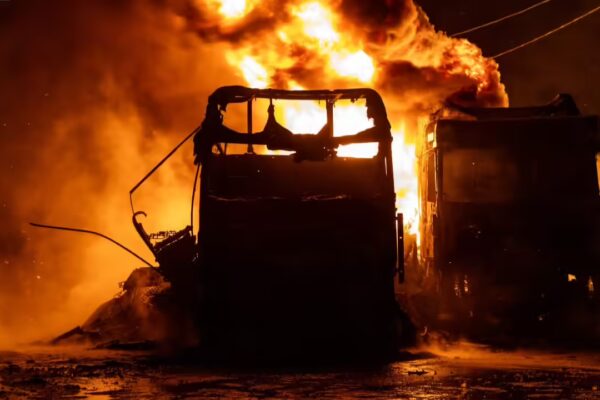
Kyiv accuses Moscow of trying to “strike the negotiation table” as one of the largest aerial bombardments of the war leaves dozens injured and critical infrastructure damaged.
Russia unleashed one of its largest air assaults of the war overnight, launching 370 attack drones and 21 missiles in waves across Ukraine, according to Ukrainian military officials. The unprecedented strike, which Ukrainian authorities said lasted nearly seven hours, targeted cities including Kyiv, Kharkiv, Odesa, and Dnipro, leaving a trail of damaged infrastructure and escalating fears that Moscow is seeking leverage ahead of potential peace negotiations.
Ukrainian Air Force Commander Mykola Oleshchuk reported that 310 of the drones were intercepted, but several missiles and unmanned aerial vehicles broke through air defenses, hitting energy facilities, industrial zones, and residential neighborhoods. “This was not just an attack against our cities,” he said in a televised address. “This was an attack against the negotiation table itself.”
Escalation Ahead of Diplomatic Push
The assault comes amid growing international speculation that Russia and Ukraine may soon face renewed pressure to seek a diplomatic resolution to the nearly two-year-long conflict. Kyiv’s accusation that Moscow targeted “the negotiation table” reflects growing unease that these attacks serve a dual purpose: to damage Ukraine’s infrastructure and to influence the country’s position in upcoming talks.
In response, Ukrainian President Volodymyr Zelensky convened an emergency National Security Council meeting early Monday, calling for accelerated air defense shipments from allies. “Each time Russia senses our diplomatic strength, it responds with terror,” Zelensky said on social media. “This is their language of negotiation.”
Russia’s Strategic Messaging
Russian state media portrayed the strikes as “retaliation” for recent Ukrainian incursions into the border regions of Belgorod and Kursk. Analysts in Moscow suggested the scale of the operation signaled Russia’s ability to sustain long-range attacks despite sanctions and battlefield losses.
Oleg Chernov, a Russian military commentator, stated on state television that the campaign was “designed to test Ukraine’s exhaustion and the West’s patience.” Western analysts, however, view the bombardment as a show of force that underscores Moscow’s unwillingness to compromise under diplomatic pressure.
Civilian Toll and International Response
Initial reports from Ukraine’s Interior Ministry indicate that at least 14 civilians were injured, though no fatalities have been confirmed as of Monday morning. Emergency crews in Kyiv battled large fires caused by falling debris, while energy operators reported widespread power outages affecting parts of central and eastern Ukraine.
The United Nations condemned the strikes as “indiscriminate attacks on civilian infrastructure,” urging both sides to protect noncombatants and return to de-escalation channels. Meanwhile, NATO Secretary-General Jens Stoltenberg reiterated that the alliance would continue supporting Ukraine “for as long as it takes.”
The Broader Significance
This latest escalation highlights the precarious balance between battlefield dynamics and diplomacy as both nations enter a third year of conflict. For Ukraine, the strikes serve as a grim reminder that the war’s frontlines now extend deep into the sky. For Russia, they represent an assertion of strength amid calls for negotiation a reminder that, for now, the path to peace remains littered with missile debris.


